4.2 Traffic
Exact accumulation can require a wider result than the input format. AUTO groups consecutive values by the narrowest supported format that preserves each exact sum. The evaluation first measures this implemented format selection, then estimates the additional benefit of compressing the remaining Kulisch groups.
Native AUTO output
Two Reduce cases fill one DATA packet per rank under the 1500-byte MTU: 726 FP16 or 363 FP32 elements. One result needs Kulisch; all others keep a native format. The baseline sends every result in uniform 320-bit Kulisch representation.
AUTO saves 29,524 RESULT-frame bytes (94.8%) in the FP16 case and 13,984 bytes (89.6%) in the FP32 case. These are deliberately constructed cases with only one value requiring Kulisch.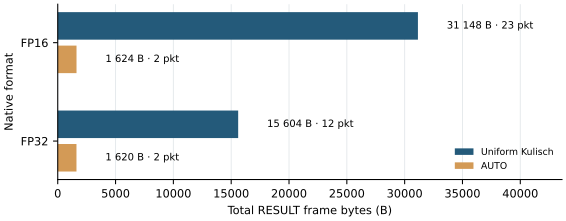
Superaccumulator compression
A serialized Kulisch value currently occupies 41 bytes: 40 bytes for the 320-bit superaccumulator and one status byte. Many accumulator bytes can be zero, so the software study extends AUTO with a choice of lossless encodings for each NumberGroup. The workload comparison jointly optimizes group boundaries, formats, codecs and packet boundaries to minimize total frame bytes. Native bit patterns can also be compressed without changing their numeric values.
For Kulisch, the proposed descriptor keeps format = KULISCH and separates encoding = RAW | RANGE | INDEX | MASK from the value count.
| Encoding | What is sent | Metadata scope |
|---|---|---|
| RAW | The full accumulator and status. | Per value. |
| RANGE | Byte containing the sign bit and rs (range size, span length in bytes), first occupied byte position, then all bytes through the last occupied position, including internal zeros. | Two metadata bytes per value. |
| INDEX | Byte containing the sign bit and ps (positions size, number of nonzero byte positions), then their position/content pairs. | One metadata byte per value and one position per nonzero byte. |
| MASK | A 40-bit mask of positions used by any value in the group, followed by those byte positions for every value. | One shared mask per group. |
The study reconstructs every finite value exactly. Native compression operates on the native word, including sign and exponent bits, so it needs no separate sign bitmap. RAW remains available. The software optimizer includes group descriptors, padding and frame headers in its objective.
For example, four ranks contribute 1, 2⁻²⁴, 0, and 0 at each of 726 positions. The nonzero inputs are FP16, but the exact sum is halfway between adjacent FP32 values. Only two accumulator bytes are active. The solution uses two MASK groups, reducing traffic from uniform Kulisch's 31,048 bytes in 21 frames to 1,676 bytes in two frames. Fixed FP32 would use 3,024 bytes and round every sum to 1.
Workload comparison
The study emulates two matrix–vector products using SuiteSparse cavity01 and bcsstk16, plus QKV and MLP projections from Pythia-14M. It generates four FP32 partial sums per output and reduces them exactly. Local products and sums are rounded to FP32. cavity01 uses its official input vector; bcsstk16 uses an all-ones vector. Vectors longer than 4096 elements are split into operations.
The four bars compare uniform Kulisch, AUTO, AUTO + adaptive compression and fixed FP32. AUTO selects formats and groups without compression; its compressed counterpart also permits lossless compression of native values. Both AUTO cases jointly optimize group and packet boundaries.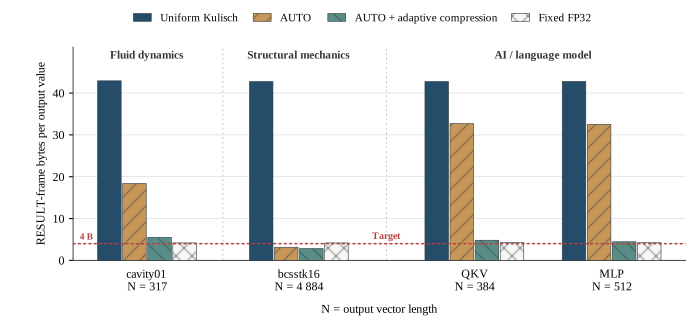
| Workload | Output values | AUTO, bytes/value | AUTO + compression, bytes/value |
|---|---|---|---|
| Fluid dynamics — cavity01 | 317 | 18.40 | 5.51 |
| Structural mechanics — bcsstk16 | 4,884 | 3.15 | 2.82 |
| Language model — QKV | 384 | 32.70 | 4.82 |
| Language model — MLP | 512 | 32.53 | 4.45 |
The compressed QKV and MLP solutions remain entirely Kulisch, using RANGE and MASK. Native-format compression saves another 24 bytes for bcsstk16, without further reductions in the other cases.
Only 39 of the 4,884 bcsstk16 outputs require Kulisch, so native AUTO already accounts for most of its saving. In the two language-model projections, most outputs need Kulisch and accumulator compression has a larger effect. Fixed FP32 uses 4.31 and 4.23 bytes/value there, at the cost of exactness.
Across these four vectors, AUTO + adaptive compression saves 87.2–93.4% of RESULT-frame bytes relative to uniform Kulisch.
These are software estimates from one emulated vector per case. They establish traffic potential for these inputs; application-level communication, training convergence, and execution time need separate studies. Native AUTO traffic comes from the Evidence sources
one_wide Kulisch runs in experiments/02-experiment-numbergroup-single/results/evaluation-cycle-exact.csv. Optimized AUTO and compression totals come from experiments/04-experiment-exact-accumulator-compression/joint_results.json; fixed Kulisch and FP32 baselines remain in results.json in that directory. JOINT_OPTIMIZER.md specifies the byte objective, codec set and optimality proof. The workload graph is copied unchanged from the thesis.