3. Architecture
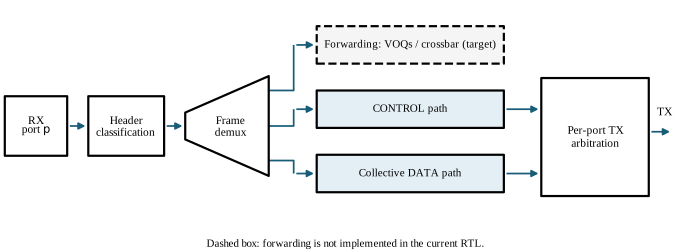
Network switches combine routing, arbitration, buffering, switching, and flow control. PRISM's target architecture extends that datapath with in-network collective reduction: ordinary frames follow the forwarding path, while locally addressed PRISM frames enter control, aggregation, result, or progress handling.
The architecture overview shows frame classification, CONTROL processing, and the collective path. Transparent forwarding, VOQs, and a general crossbar remain future extensions.
The current implementation is a collective node with NUM_PORTS full-duplex 512-bit AXI4-Stream ports: two by default, one in the U280 board build. It consumes locally addressed PRISM CONTROL and DATA frames, performs a configured reduction, and generates CONTROL responses and RES frames. Unsupported or non-local traffic is drained; the RTL does not provide transparent Layer-2 forwarding.
The ordered RTL inventory is repo/prism-hdl/rtl.f. The reusable root is prism_collective_core; prism_sim_top adapts it to verification and prism_u280_top to the 100G port of the Alveo U280.
Next pages
- 3.1 Protocol: packet layouts, registries and configuration records shared by the RTL and the CCL.
- 3.2 Pipeline: the path from per-port ingress through control, reduction and result storage to egress.
- 3.3 Parameters: wire constants, elaboration parameters, runtime state and derived values.
- 3.4 RTL modules: the state-owning modules and the board top.
The protocol defines the wire format and the target behaviour; the pipeline page separates that target from what the RTL implements today.